Advertisement

Teotihuacán, Mexico. Wirestock Creators/Shutterstock
If you're planning to visit Teotihuacán, there are a few things to consider to get the best out of your trip. Of all the wonderful sights around Mexico City, nothing quite compares to these awe-inspiring ancient ruins, though the greatest pre-Aztec city in Mesoamerica always draws a crowd.
Why visit Teotihuacán? Well, this complex of majestic monuments, 50km northeast of Mexico City, is one of the most significant archaeological sites in the Americas. Looming over a dusty plain, its towering stone pyramids rival the famous temples of Yucatán and Chiapas – and even the Pyramids of Egypt – but the ruins get busy at weekends during the peak winter season from November to April, so be ready to share the experience.
It's worth taking your time on a day trip to Teotihuacán from Mexico City. The ancient city covered more than 20 sq km, and most of what can be seen today spills across a core zone spanning nearly 2km, following the route of the Calzada de los Muertos (Avenue of the Dead).
Here's what you need to know to get more from your visit to Teotihuacán.

Advertisement
Is it easy to get to and around Teotihuacán?
A day trip to Teotihuacán from Mexico City is easy by taxi or public transport. During daylight hours, public buses run by Autobuses México–San Juan Teotihuacán depart regularly for Teotihuacán from Mexico City’s Terminal Central de Autobuses del Norte, taking about an hour. However, there have been robberies on these buses; for safety, many visitors prefer to arrange a ride via Uber.
Think about which gate you plan to arrive at. The archaeological zone has five gates, and these are widely spaced around the complex. Enter via Gate 1 for La Cuitadela and the south end of the Calzada de los Muertos. Gate 2 is the closest gate to the Pirámide del Sol, while Gate 3 will bring you to the Pirámide de la Luna.
Tours are plentiful and they offer better value for solo travelers than taking a cab. Trips depart conveniently from Zócalo square in the historic heart of Mexico City. Turibús and Capital Bus run day trips in open-top buses, and the tour price includes a bilingual guide and entrance fees.
Tours also stop at the Basílica de Guadalupe, an important Catholic pilgrimage site in Mexico City's northern suburbs. Taking a day tour that includes transportation and a guide can work out cheaper than making your own way to Teotihuacán and hiring a guide at the entrance.

How much does it cost to visit Teotihuacán?
Considering how much there is to see and the fact that this is one of the top things to do in Mexico, the Teotihuacán entrance fee is excellent value. Admission to the park is 100 Mexican pesos (M$), less than the cost of a cafe breakfast in Mexico City. For an additional fee (from M$800 per group), a guide will show you details of the site that you might otherwise miss.
How much time should I spend in Teotihuacán?
Factoring in the time it takes to get here from Mexico City (about an hour each way), you'll want to set aside at least half a day to visit Teotihuacán. The archaeological zone opens daily from 8am to 5pm, and the last admission is at 4:30pm, but try to arrive by mid-afternoon, as the site warrants several hours of exploring.
The best time to visit Teotihuacán is in the morning before the crowds gather, avoiding the draining heat in the middle of the day. There is little shade at Teotihuacán, so wear a hat, apply sunscreen, and carry plenty of drinking water as you explore this vast complex.
If you book a hot-air balloon ride over the ruins, you'll leave Mexico City before dawn, take your flight, and then stop for breakfast, before exploring Teotihuacán at ground level. Expect to be back in Mexico City in time for lunch.

Who built Teotihuacán?
Teotihuacán was once the largest city in ancient Mesoamerica – the capital of a huge pre-Hispanic empire. In its prime, the ancient city was dominated by soaring pyramids and palaces and adorned with colorful frescoes, home to a highly developed society with complex religious and funerary rituals. Yet tantalizingly little is known about the people who founded Teotihuacán in the 1st century CE.
What is known is that the city grew rapidly and became a major hub for regional migration, with different ethnic groups living in segregated neighborhoods, which possibly led to its downfall. Archaeologists believe that tensions between these varied groups over culture and status led to the city’s collapse in the 8th century. The ruins were later reclaimed by other regional peoples, including the Aztecs in the 15th century.
Archaeologists believe that Teotihuacán’s orderly grid of pyramids and avenues was laid out in the early part of the 1st century CE. The Pirámide del Sol was completed over the site of an earlier cave shrine by around 150 CE. The rest of the city was developed between 250 and 600 CE, becoming a major power in the Americas.
The city is divided into quarters by two great avenues that meet near La Ciudadela (the Citadel). Running roughly north–south, the famous Calzada de los Muertos (Avenue of the Dead) got its name from the Aztecs, who believed the great buildings lining it were vast tombs built by giants for Teotihuacán’s first rulers.

Advertisement
The major structures at Teotihuacán are gigantic, stepped, pyramid-like buildings consisting of both talud (sloping) and tablero (upright) sections, surrounded by smaller ceremonial structures. In their prime, many of Teotihuacán's palaces and pyramids were covered in lime plaster and colorfully painted. Beyond these ritual hubs, most of the city was made up of residential compounds, some of which contained elegant frescoes.
Centuries after the city’s fall, Teotihuacán remained a pilgrimage site for Aztec royalty, who believed that all of the gods had sacrificed themselves here to start the sun moving at the beginning of the fifth world, the final phase in the cycle of destruction and recreation of the world in Aztec mythology.
Preserved today as a UNESCO World Heritage Site, Teotihuacán remains an important pilgrimage site. Thousands of indigenous people and New Age devotees flock here each year to celebrate the vernal equinox (between March 19 and 21) and soak up the mystical energies believed to converge here.

What are the top things to do at Teotihuacán
There's plenty to see at Teotihuacán. Allow at least two hours to see the main structures, or more if you want to investigate at a more relaxed pace.
Wander along the Calzada de los Muertos
Running north to south, the broad and imposing Avenue of the Dead connects most of the important sites at Teotihuacán. Entering via Gate 1 will bring you to the south end of Calzada de los Muertos, in front of the La Ciudadela complex, while Gate 3 will place you at the north end.
Running north from La Ciutadela for 2km, the avenue is flanked by the former palaces of Teotihuacán’s elite and other major structures, including the Pirámide del Sol, about halfway along near Gate 2. At the far end, the Pirámide de la Luna looms large; look out for the mysterious mural of a puma (or jaguar) on a wall between these two enormous pyramids.

Look up at the towering Pirámide del Sol
The world’s third-largest pyramid, the Pirámide del Sol (Pyramid of the Sun) is surpassed in size only by the Great Pyramid of Khufu at Giza in Egypt and the Great Pyramid of Cholula near Puebla. This vast structure soars over the east side of the Calzada de los Muertos. When Teotihuacán was at its peak (between 375 and 500 CE), the pyramid’s plaster was painted bright red, which must have been a radiant sight at sunset.
While you can no longer climb up the pyramid’s 248 uneven steps to protect the site from damage, standing next to this towering structure will still take your breath away. The pyramid's stepped tiers rise above you, while the Calzada de los Muertos stretches north toward the Pirámide de la Luna, and south toward the La Ciudadela.
Admire the frescoes in the Palacio de Tepantitla
About 500m northeast of the Pirámide del Sol, this priest’s residence contains Teotihuacán’s most famous fresco, known as the "Paradise of Tláloc." The rain god Tláloc is shown attended by priests, with people, animals and fish nearby.
Above is a sinister portrait of the Great Goddess of Teotihuacán, thought to be a goddess of darkness and war because she’s often shown with jaguars, owls and spiders, which were considered underworld animals. Look for her fanged nosepiece and shields adorned with spiderwebs.

Admire the Pirámide de la Luna
At the north end of the Calzada de los Muertos, the Pirámide de la Luna (Pyramid of the Moon is smaller than the Pirámide del Sol but more gracefully proportioned. Completed in around 300 CE, the pyramid appears to be nearly the same height as the Pirámide del Sol because it’s built on higher ground.
Climbing the steep stairway to the top of the Pirámide de la Luna has been banned since 2020 to preserve the structure, but there is plenty to see in the collection of ruined palaces and plinths surrounding the plaza to the south of the pyramid.
Southwest of Pirámide de la Luna is the Palacio de Quetzalpapálotl (Palace of the Quetzal Butterfly), thought to have been the home of a high priest. The remains of bears, armadillos and other animals were discovered here, suggesting that this site was used by the elite for cooking and rituals.
The Templo de los Jaguares (Jaguar Temple) and Templo de los Caracoles Emplumados (Temple of the Plumed Conch Shells) are behind and below the Palacio de Quetzalpapálotl. The lower walls of several chambers off the patio of the Jaguar Temple feature partial murals depicting the jaguar god blowing conch shells and praying to the rain god Tláloc.

Examine the carvings of the Templo de Quetzalcóatl
Rising at the heart of La Ciudadela (the Citadel), Teotihuacán's third-largest pyramid is also its most ornate. The four surviving steps of the facade (there were originally seven) are adorned with striking carvings of mythical beings.
On the tablero (right-angled) panels, a feathered serpent deity alternates with a two-fanged creature identified as the fire serpent who carries the sun on its daily journey across the sky. Imagine its eye sockets laid with glistening obsidian glass and the pyramid painted blue, as it was in Teotihuacán's heyday.
The surrounding La Ciudela complex is believed to have been the residence of the city’s supreme ruler, and its rooms may have been the city’s administrative center. Four wide walls topped by 15 pyramids enclose a huge open plaza. Archaeologists believe the pyramids represented mountains during rituals where the plaza, representing the world of the living, was deliberately flooded.
Take a hot-air balloon ride over the pyramids
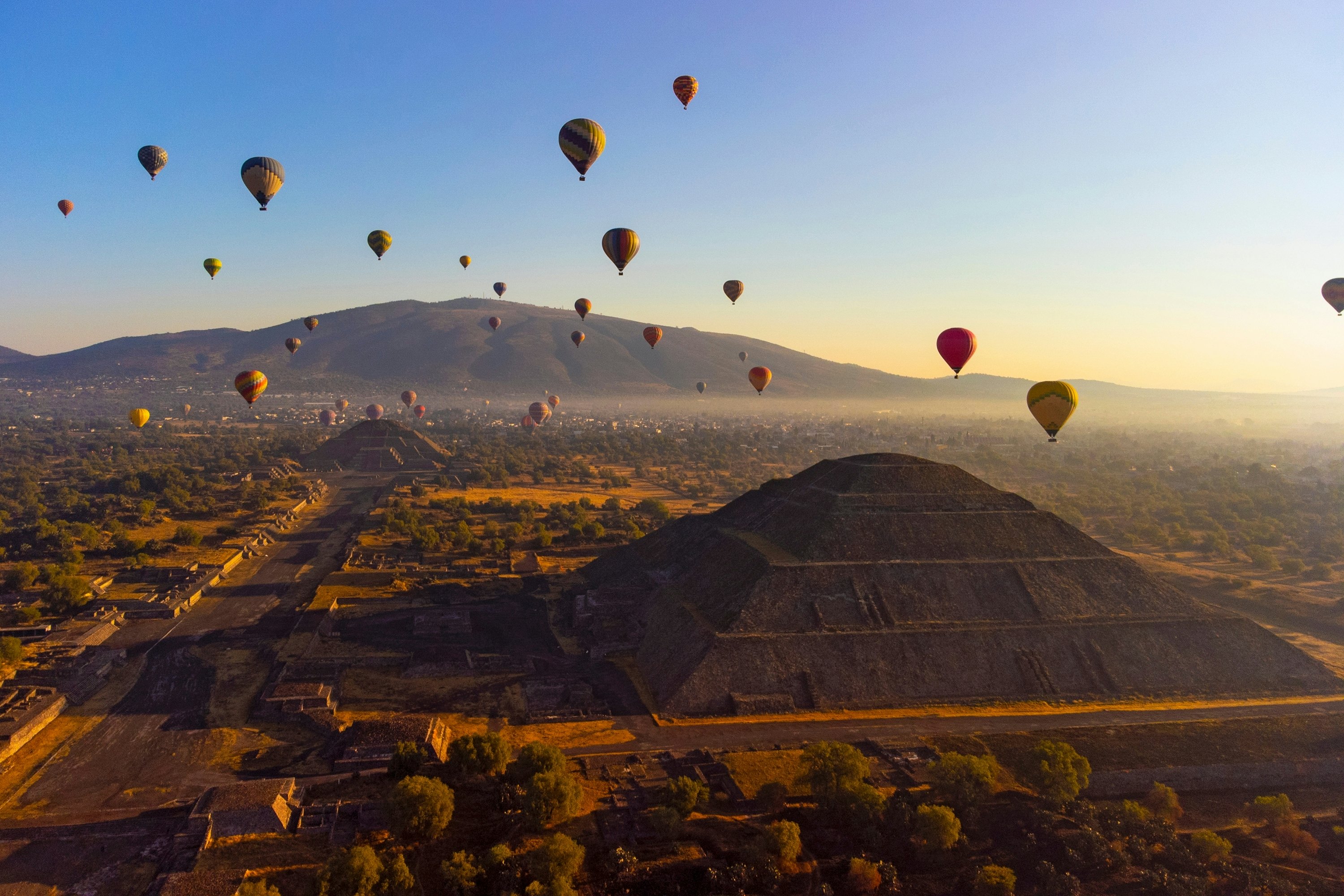
Seeing the pyramid complex from a hot-air balloon provides another level of excitement. As you gaze out across the landscape of the ancient city, dozens of other hot-air balloons in rainbow colors hover over the sun-kissed pyramids like sentinels.
Balloon operators will take you right over the Pirámide del Sol – close enough to see the steps. The pyramids were an attempt by mere mortals to recreate the might of mountains, and as your balloon jets hot air into the sky, you might feel like a deity gazing down on Teotihuacán.
Balloon flights depart from the Municipality of Teotihuacán between 5am and 6am and typically last 45 minutes to an hour. We Fly Teotihuacán offers shared and private trips, including pickup and drop-off from the Angel of Independence in Mexico City; prices start at around M$2640.
Dine in a cool cave at Teotihuacán
Dining options at Teotihuacán are mostly overpriced and uninspiring, but Restaurante La Gruta, a short distance from Gate 5, is worth investigating. Set in a vast cave, the restaurant is unapologetically gimmicky, but it offers a unique and entertainingly kitsch eating experience. Its high ceiling means there’s little sense of being closed in, and you’ll be thankful for the cool interior after a day in the sun.
The dark setting also ensures every meal is romantically lit, no matter the time of day. The menu includes familiar Mexican and pre-Hispanic fare such as mole (a chocolate-infused sauce served with chicken), barbacoa (roast beef or lamb), tamales, tostadas de cochinita (pulled pork on crispy tortillas) and tacos, with surprisingly good escamoles (ant larvae).
The menú del día (daily set menu) is the best value option. At the end of your meal, you'll be given a candle to place at the far depth of the cave as a nod to the ritual of rebirth performed here by pre-Hispanic people. On Saturday and Sunday afternoons, there is a 40-minute folk dance show; reservations are recommended.

See the spring equinox
Each year at the return of spring, when the Northern Hemisphere begins to tilt back toward the sun, thousands of believers in cosmic energy dress in white and flock to Teotihuacán to embrace the sun’s first rays during the equinox, when the energy fields are meant to be at their strongest.
Archeoastronomy – the study of ancient civilizations’ knowledge and use of the stars and other celestial bodies – has revealed that the Palace of Quetzalcóatl functioned as a solar observatory. At the spring equinox, the rays of the rising sun create shadows along red-painted owls on the wall. The bird was a symbol of stars, representing both darkness and light.
Top tips when visiting Teotihuacán
There is virtually no shade, so bring a hat or buy an inexpensive one on arrival.
Bring snacks and water. Most eating options here are mediocre restaurants catering to tour buses, set away from the site gates.
Do not try to climb on the pyramids. Due to damage from tourists climbing the Pirámide de la Luna and Pirámide del Sol in the past, ascending the steps was banned in 2020 to preserve the structures.
Clap your hands near the Pirámide del Sol or Pirámide de la Luna to produce echoes that mimic a quetzal’s call.
Stand by the Pirámide de la Luna and turn to face the Pirámide del Sol; you’ll notice that its silhouette replicates that of the hill behind it.
Advertisement
Take your Mexico trip with Lonely Planet Journeys
Time to book that trip to Mexico
Lonely Planet Journeys takes you there with fully customizable trips to top destinations – all crafted by our local experts.