Advertisement

Sossusvlei, Namibia. Radek Borovka/Shutterstock
Sprawling beside the Atlantic Ocean but dry as a bone, rich in history and wildlife but famed for its empty spaces, Namibia is a bit of an enigma. Sometimes overshadowed by neighboring South Africa and Botswana, the country claims top attractions that speak for themselves: Africa’s largest canyon, its oldest desert and some of its highest sand dunes, as well as the wild, dune-backed beaches of the dramatic Skeleton Coast, one of the best places to visit in a land known for unforgettable experiences.
Despite the dry terrain, you'll find plenty of life in Namibia's national parks. The country's sun-baked deserts are nourished by fog that rolls in from the icy Atlantic, enabling these seemingly empty expanses to support a wide variety of drought-adapted plants and animals.
Namibia is best suited to a self-driving trip. Many destinations are not serviced by public transportation, and rental cars are reasonably priced. Main roads are generally good, as are many secondary roads. (Expect some seasonal flooding – never drive through riverbeds before checking locally on conditions.) Just be sure to fill up on fuel in major towns like Windhoek, Swakopmund and Outjo before remote drives.
With such solid infrastructure and a well-developed tourism industry, exploring Namibia's best places to visit is a delight.

Advertisement
1. Etosha National Park
Best for a safari
Etosha National Park is Namibia’s top safari destination, famed for huge herds of zebras, wildebeest and impalas that gather around watering holes during the dry season, as well as the flocks of flamingoes that make their way to the Etosha salt pan to breed during the rainy season.
Etosha is also notable for its critically endangered black rhinos, which number among the largest populations on the continent. One of the best places to spot them is the floodlit water hole at Okakuejo, close to the Okaukuejo Camp. Take a 4WD safari to get within snapping distance of wildlife all over the park.
Planning tip: Etosha is ideally set up for a self-driving road trip, with a well-spaced network of bush camps and a good road network. The best wildlife watching is in the cooler, dry months (late June to September); in the hot, wetter summer (November through April), you’ll be treated to greener landscapes, fewer visitors and young animals during calving season
2. Windhoek
Best for Namibia’s history
The country’s lively capital, perched atop an inland plateau at about 1700m above sea level, Windhoek is one of the world’s highest capital cities. It's also Namibia’s main urban hub and the best place in the country to buy crafts and stock up on supplies. Devote at least a day to exploring historic landmarks such as Christuskirche and the National Museum, with its displays on the country's path to independence.
Detour: Surrounding Windhoek and rising to 1700–2000m in altitude are the Khomas Highlands. Come to admire the open grasslands and rolling hills, and check out the wildlife at tiny Daan Viljoen Game Park on Windhoek’s western edge or N/a'an ku sê Wildlife Sanctuary to the east.

3. Skeleton Coast National Park
Best for solitude
Stretching for 500km along Namibia’s northwestern shoreline, Skeleton Coast National Park is splendid in its desolation. These barren, wave-pounded sands have long formed a graveyard for washed-up whales, seals, ships and even some hapless humans. But a visit to the seal colonies along the shore will remind you that there's life here still.
Permits are required to explore the park’s northern section, but you can get a good sense for the area in the lower portion of the park, between the Ugab River entrance and the fishing center of Terrace Bay. The quiet is broken during the December to January high season, when this patch of shore becomes a favored destination for anglers.
Planning tip: A 2WD vehicle is fine year-round as far as Ugabmund and usually onward to Terrace Bay, although for comfort or to go anywhere off the main road, 4WD is better. Beyond Terrace Bay, you’ll need to be part of an organized 4WD or fly-in safari. The coastal C34 road is in part built from salt but generally is in excellent condition.
4. Swakopmund
Best for adrenaline-pumping activities
Dune boarding, skydiving and surfing are just some of the many activities possible in Swakopmund, Namibia’s adventure capital. With its chilled-out vibe, German-influenced architecture and numerous activity companies, the town has become an established stop on the travel circuit, and you'll also find a good range of restaurants and accommodations.
Just 35km south is Walvis Bay, known for its flamingos and other wetland birdlife, and nearby is the 383m-high Dune 7, Namibia’s highest sand dune. Further along the coast, don’t miss Sandwich Harbour; its bird-filled lagoon is set dramatically against a backdrop of towering dunes.
Detour: Distances between attractions along the central coast aren’t too onerous, particularly if you have a rental vehicle. Don’t miss taking a day trip from Swakopmund north to Cape Cross Seal Reserve, where you can see, hear and smell thousands of Cape fur seals as they lounge on the beach and frolic in the waves.
Advertisement

5. Damaraland
Best for desert wildlife
Damaraland, nestled between Etosha National Park and the coast, is a hauntingly beautiful region where elephants and lions roam amid craggy rock formations. Even the plants are adapted to the parched conditions – look out for gnarled Welwitschia mirabilis plants and quiver trees, once used by the San people to make quivers for arrows.
Damaraland is also the site of one of Africa’s most extensive collections of rock art. At Twyfelfontein you can see more than 2500 engravings, depicting wildlife and geometric patterns.
Detour: There’s more rock art several hours' drive to the south at Brandberg's Tsisab Ravine, or Fire Mountain. Watch the sun set against the red rocks to see how it got its name.
6. Lüderitz
Best for coastal wildlife
Lüderitz, the largest population center in southwestern Namibia, has an incongruous setting, sandwiched between the sea and the desert. With its busy port, single access road and early 20th-century German-style architecture, the town has a time-warped, end-of-the-world feel.
About 20km west of Lüderitz around the bay is Diaz Point, a rocky, wind-buffeted outcrop known for its seabirds and seals. Southeast of Lüderitz is the evocative ghost town of Kolmanskop, a mining settlement that is slowly being taken over by the desert.
Detour: To the south, the empty expanses of Tsau //Khaeb (Sperrgebiet) National Park are accessible on day trips from Lüderitz. This former diamond-mining region is a biodiversity hot spot with a diverse array of succulent plants. On the park’s eastern edge, near the small town of Aus, look out for survivors of the area’s once-large population of wild horses.

7. Sossusvlei
Best for photography
In the heart of the Namib Desert is the tiny enclave of Sesriem, the gateway to Namib- Naukluft Park and the stunning dune panoramas around Sossusvlei and Deadvlei. The salt and clay pans are a photographer’s dream – the sharp lines of the surrounding dunes in stark contrast to the clear blue skies.
Climbing these giant dunes is another must-do on a trip to Sossusvlei. Nearby are some lovely desert lodges, and not far away is NamibRand Nature Reserve, a designated dark sky reserve where you can take in a light-pollution-free panorama of stars.
Planning tip: Spend the night at the Sesriem campsite inside the main park gate or at one of the lodges inside the park to climb Big Daddy or Dune 45 while the air is cooler and the sun is still relatively low in the sky. For another perspective on this humbling landscape, try a sunrise hot-air balloon safari.
8. Kunene Region (Kaokoland)
Best for remoteness
In Namibia’s far northwestern corner, the remote and seldom visited Kunene region's isolated valleys, empty scrublands, rugged mountains and silent deserts are home to the seminomadic Himba people, known for the custom of wearing red ochre paste on their skin and hair. You’ll have many opportunities to meet members of the Himba community and learn about their culture.
Kunene is fringed to the north by the sandbanks and waterways of the Kunene River delta. East of here, the winding Kunene River, which forms Namibia’s border with Angola, flows past pretty Epupa Falls and some lovely riverside lodges.
Planning tip: Visiting Kunene is a proper adventure. Fully equipped 4WD excursions and fly-in tours are the main ways to explore the region.
9. Southern Namibia
Best for canoeing
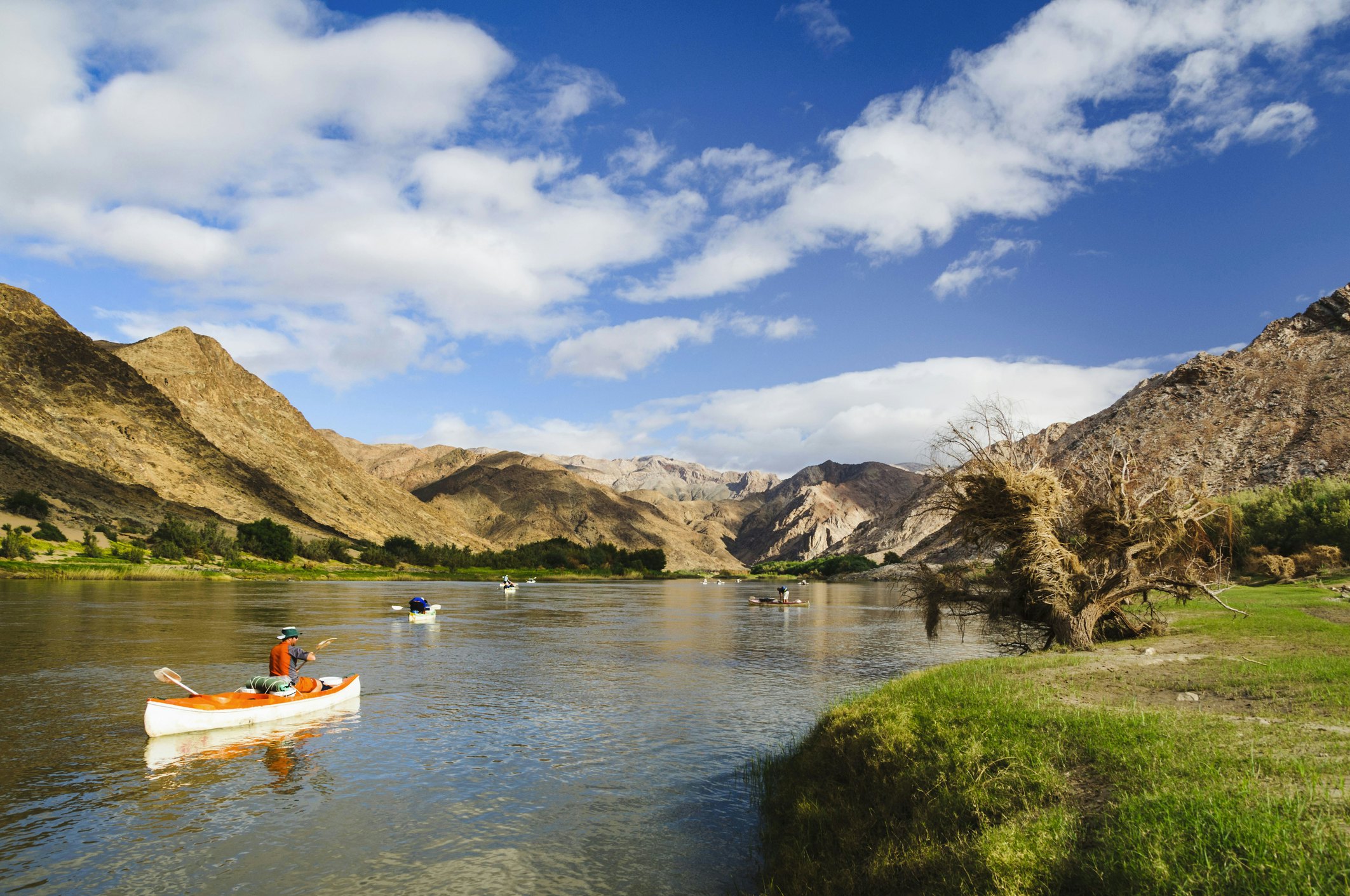
The Orange River, which forms Namibia’s border with South Africa, is all about multiday canoe trips – paddle by day, camp under the stars by night and spend lazy afternoons relaxing on the riverbanks.
The vineyard-fringed border town of Noordoewer is a popular base. Combine 4 or 5 days on the river with a visit to the viewpoints overlooking the vast and ruggedly beautiful Fish River Canyon. To the north is |Ai-|Ais/Richtersveld Transfrontier Park, a setting for self-sufficient, off-grid adventures.
Planning tip: Outdoorsy families will relish time floating on the Orange River, but plan to do this outside of summer (from late November to March) due to the heat, which typically exceeds 30°C (86°F) at the warmest point in the day.

10. Zambezi Region
Best for water-based wildlife
Northeastern Namibia is far removed from Windhoek and much of the rest of the country, both in distance and in feel. Its languid waterways offer a complete contrast to the arid desert landscapes more prevalent in the south, and the far northeast is an ideal detour if you’re combining travel in Namibia with a trip to Victoria Falls, spanning the border between Zambia and Zimbabwe.
The focus in northeastern Namibia is Bwabwata National Park, where you can soak in the sounds of the African bush in the relaxed lodges and campgrounds, then spot hippos and elephants splashing along the banks of the Okavango River and Kwando River.
Planning tip: While the eastward B8 highway through Zambezi is flat, straight and in excellent condition, almost everywhere off this is wild and rugged. For any forays away from the tarmac, you’ll need a 4WD with high clearance. It’s essential to consider seasonal water variations, as flooding and rains can make some areas inaccessible.
11. Northern Namibia
Best for local culture
Densely populated northern Namibia is the cultural heartland of the Owambo people, Namibia’s largest ethnic group. You can learn about Owambo culture around the town of Ondwangwa, then visit the moving memorial marking the birthplace of Namibian independence at Omugulugwombashe.
Planning tip: For a deeper dive into the region's culture, attend a local festival such as Oshituti Shomagongo in March or April, which is devoted to the area's famous marula fruits, and sample some omagungu (mopane worms) and omboga (greens) at one of the region’s many small eateries.
12. Waterberg Plateau
Best for sandstone cliffs
There’s just a hint of The Lost World as you make your way up the 150m-high Waterberg Plateau – the centerpiece of Waterberg Plateau National Park – with its striking sandstone cliffs, lianas, bird-filled forest canopy, elusive wildlife and even dinosaur footprints.
Set off on one of the park-run guided wildlife drives, which take about 4 hours, and visit several hides overlooking water holes. You’ll likely see various antelope, including elands and sable, roan and red hartebeests, and with luck you may also spot buffaloes, rhinos and perhaps even a leopard, as well as some of the 200-plus species of birds. The plateau’s biodiversity is stunning, and you’ll be surrounded by its impressive array of flora while on top of the plateau and along its sides.
Planning tip: Once back in camp, you can do several 1- to 2-hour walks on your own within the park's boundaries. The best is the Mountain View Trail, which starts near the NWR resort.
Advertisement